If you have been told you need a pelvic ultrasound, you may also have heard the term "transvaginal ultrasound" and wondered whether they are the same test. They are related, but not identical. Both are pelvic ultrasound studies, both use harmless sound waves instead of radiation, and both are performed in minutes, yet they answer different clinical questions and look at the pelvis from different angles. Understanding the difference helps you ask better questions, arrive prepared, and know what to expect.
What Is a Pelvic Ultrasound?
A pelvic ultrasound is a broad category of imaging that evaluates the organs of the female pelvis, including the uterus, cervix, ovaries, fallopian tubes, and the surrounding pelvic structures. The bladder and pelvic floor may also be assessed. There is no radiation involved, so the exam is safe during pregnancy and can be repeated as needed.
Pelvic ultrasound is used to investigate pelvic pain, abnormal or heavy bleeding, fibroids, ovarian cysts, fertility concerns, and pregnancy. The same exam helps clinicians monitor a known finding over time or confirm that everything looks normal.
The important detail is that "pelvic ultrasound" describes the target, not the technique. To see those organs clearly, the sonographer can take one of two approaches: transabdominal, where the probe rests on your lower belly, or transvaginal, where a slimmer probe is gently placed inside the vagina. Many appointments combine both so the physician gets the complete picture.
Transabdominal vs Transvaginal: How the Two Exams Differ
The two approaches differ mainly in how close the probe gets to the organs and how much detail the image can capture.
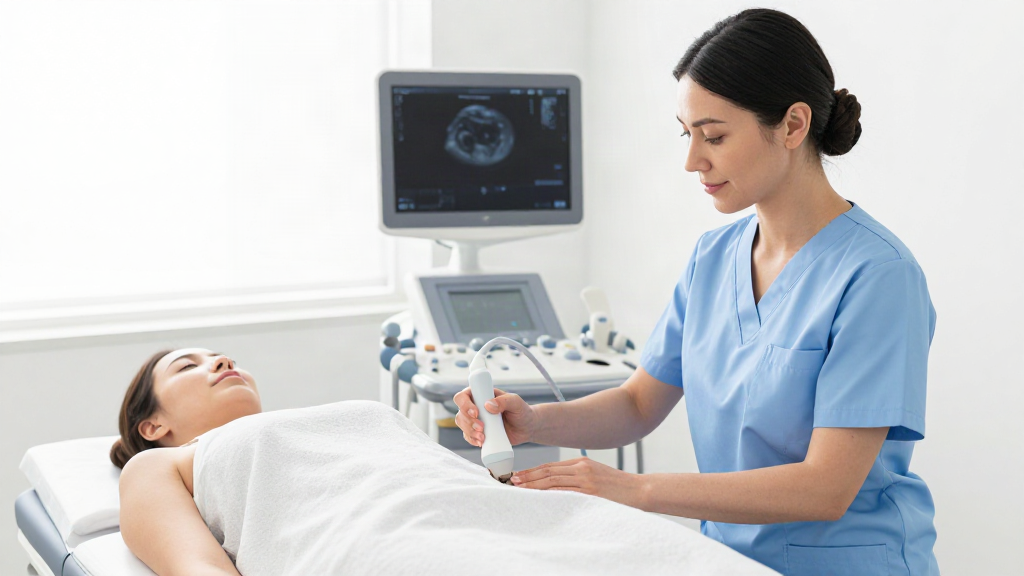
A transabdominal pelvic ultrasound is done from the outside. You will be asked to arrive with a full bladder, because a full bladder pushes the uterus into a better position and acts as a window that sound waves travel through. The sonographer glides the probe across your lower abdomen with a small amount of warm gel. It is entirely painless, and the wide field of view makes it ideal for surveying the whole pelvis at once, including larger structures such as significant fibroids or an enlarged uterus.
A transvaginal ultrasound is done from the inside. The transvaginal probe is thin, covered with a sterile sheath, and lubricated. It is inserted a short distance into the vagina, and because the probe sits directly beside the uterus and ovaries, it produces much higher-resolution images. This is why it is the preferred method for fine detail: the thickness of the uterine lining, small ovarian follicles, early pregnancy, and subtle abnormalities that a transabdominal scan might miss.
Neither approach is more "advanced" than the other in a general sense. They are tools suited to different jobs, and the choice, or the combination, depends on what your physician needs to see.
Which Exam Is Right for You? Clinical Scenarios
Your provider usually selects the approach based on your symptoms, your history, and what the question is.
When transabdominal ultrasound is often the starting point
A transabdominal pelvic ultrasound is frequently the first step when a broad overview is needed: a general pelvic survey, an evaluation of a large fibroid or an enlarged uterus, or a baseline scan. It is also the standard approach for a patient who prefers not to have an internal exam. Because the field of view is wide, it can show the relationship between organs and catch findings that extend beyond the pelvis.
When transvaginal ultrasound gives the clearer answer
A transvaginal ultrasound is commonly recommended when the question is precise. Examples include investigating the uterine lining for abnormal bleeding, evaluating the ovaries and follicles in a fertility workup, confirming and dating an early pregnancy, and following a small cyst or polyp. Its proximity to the organs makes it the more sensitive exam for early or subtle findings.
During pregnancy, the two are often used together and at different stages. An early first-trimester scan is usually transvaginal, where the embryo can be seen sooner, while later scans increasingly rely on the transabdominal view as the uterus rises out of the pelvis. Expectant parents seeking elective or 3D/4D/5D keepsake imaging usually have a transabdominal scan.
If you are unsure which exam your situation calls for, that is a clinical decision, not a guessing game. Your referring provider or our team can clarify what has been ordered and why.
What to Expect at Each Appointment
For a transabdominal pelvic ultrasound, drink water and finish it about an hour before your appointment so your bladder is comfortably full, then expect a quick, painless scan across your lower abdomen.
For a transvaginal ultrasound, the opposite preparation applies: come with an empty bladder. You will be given privacy to undress from the waist down and a sheet to cover up. The probe is inserted gently, and most patients describe the sensation as pressure rather than pain. The exam typically takes fifteen to thirty minutes.
At S&S Life Scan in Arlington, our ARDMS-certified sonographers walk you through each step, explain what they are doing, and keep the room comfortable and private. Results are read by a physician and returned within 24-48 hours, so you are not left waiting on answers.
If your appointment includes both approaches, you will usually start with the transabdominal scan while your bladder is full, then empty it before the transvaginal portion.
Why Patients Across DFW Choose S&S Life Scan
Whether your exam is ordered by a physician, your office, or a clinic, we deliver the full range of pelvic and diagnostic ultrasound in one convenient Arlington location: pelvic ultrasound, abdominal, renal, thyroid, breast, vascular, carotid, echocardiogram, and more. You get diagnostic-grade equipment, a caring team, and clear pricing with affordable cash-pay rates for patients with or without insurance. No hospital maze, no needless delay, just an accurate scan and a prompt report.
The Bottom Line
Transvaginal and transabdominal pelvic ultrasound are partners in the same toolkit, not competitors. The transabdominal view gives a wide survey from the outside; the transvaginal view delivers high-resolution detail from close range. Your provider chooses, or combines, them based on what needs to be seen, and sometimes the answer is both.
If you have been referred for a pelvic ultrasound in and around Arlington, TX, we can help you schedule the exam, explain the preparation, and get your results back fast. Explore our services or book your appointment with S&S Life Scan and get the clarity you deserve.